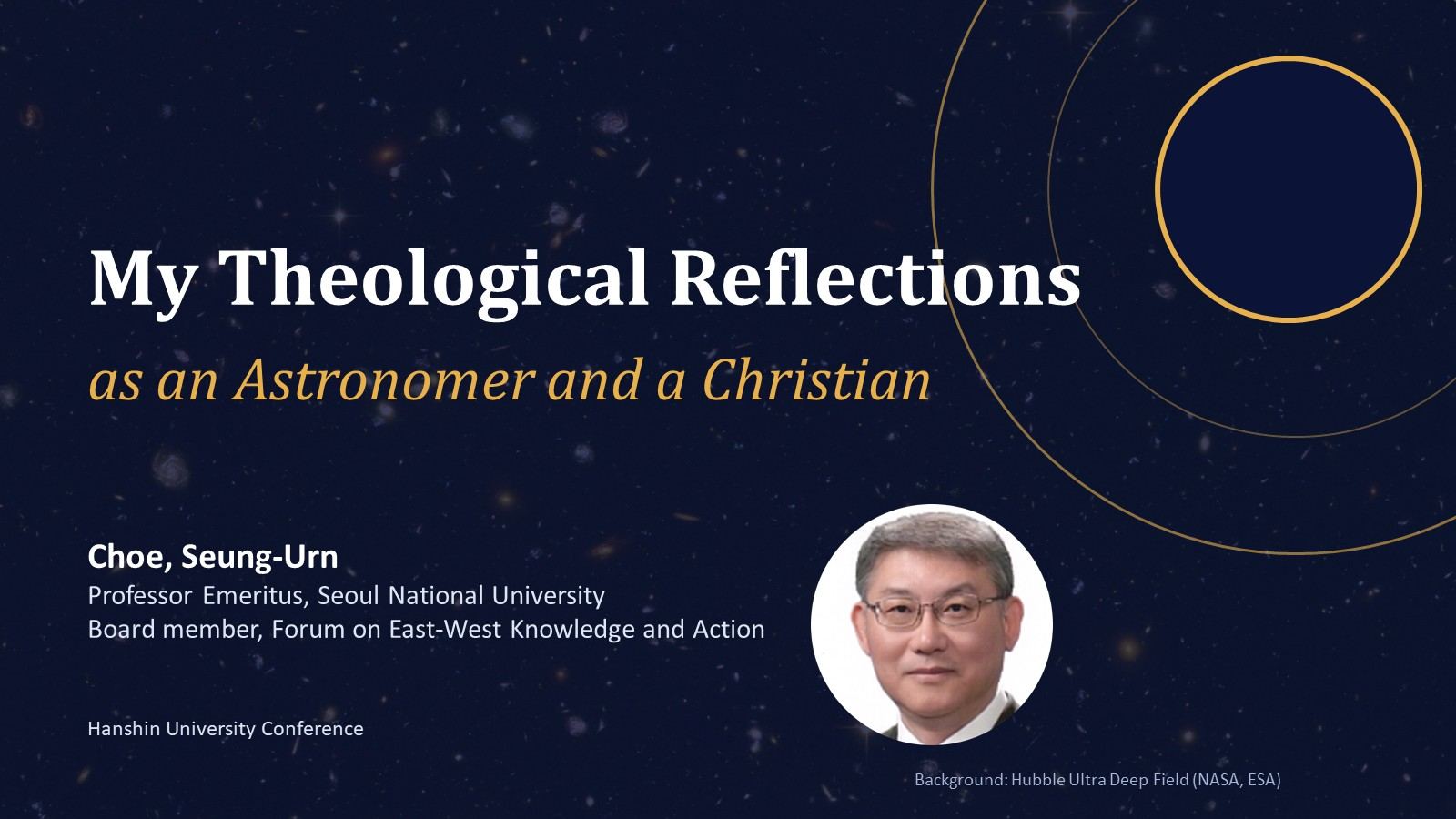
Paper read at the International Conference for the Centenary of Jürgen Moltmann, Hanshin University Graduate School of Theology, 29 September 2026.
I am deeply moved to be presenting my talk at this conference hosted by Hanshin University. First, I give thanks to God for His grace. I also extend my gratitude to everyone who made it possible for me to give this presentation.
Several years ago, Dr. Lim Chang-se proposed to me a gathering where scientists and theologians could come together to study the intersection of science and theology; consequently, a group of over ten scientists and theologians formed the "Science and Theology Research Group" succeeding the "Isu Forum" launched 15 years prior and has been actively engaged in this work ever since. This research group operates under the Science-Theology Concert Team of the Forum on East-West Knowledge and Action and maintains a Memorandum of Understanding (MOU) with The International Public Theology Forum-Center in Berkeley (IPTFC). This session for presentations by the group has been arranged for the second day of this conference.
I am an astronomer and an educator. Although I am an ordained minister—having graduated from a seminary—strictly speaking, I am not a theologian. I simply have an interest in theology and have studied various theological fields at an amateur level. Therefore, my presentation reflects the perspective of someone trained in astronomy and science education; I aim to share a testimony regarding Christian faith and theological reflection, drawing upon the journey of my own Christian life.
I feel quite overwhelmed to be in the presence of such renowned theologians at this conference. Although I studied in the United States, it was so long ago that I am quite rusty when it comes to speaking English. I prepared this presentation using an English translation tool; if it sounds decent, it is simply because the tool has flattered my actual language skills. Furthermore, as my hearing is not very good, I would greatly appreciate it if you could speak very slowly when asking questions after my presentation.
As my presentation time is limited, I will skip the sections titled "My Journey to Embracing the Christian Faith" and "The Latest in Astronomy Encountered While Studying Abroad."
1. My Journey to Embracing the Christian Faith
As you know, after the Korean War, our country was a place where life was extremely difficult in every respect. Born in 1954, I attended elementary and middle school during the 1960s. My family faced severe financial hardship, and because I grew up in a household that followed Buddhism or superstitions, I never attended church regularly. However, I would sometimes tag along with friends to church on Christmas or Easter—occasions when we were given pencils and notebooks—or join in Christmas caroling to enjoy some delicious food. I had to balance my studies with earning money by delivering newspapers, and I often envied my church-going friends, who seemed to be living slightly better lives than I was.
I entered high school in 1970, but financial difficulties made it hard to continue my studies there; however, I happened to pass the college entrance qualification exam—thereby gaining the equivalent of a high school diploma—and was able to enter Seoul National University in 1972. Although I had wanted to major in physics, my entrance exam scores were not high enough, so I ended up entering the Department of Astronomy and Meteorology, my second choice. From that point on, I studied astronomy and naturally expanded my studies to include physics, mathematics, and computer science. Looking back now at the age of 72, I reflect on how—through unexpected turns of fate—I came to take and pass that qualification exam and subsequently study astronomy, physics, mathematics, and computer science at Seoul National University.
I decided to study in the United States quite by chance while chatting with my girlfriend; thanks to her help, I applied to and was accepted into the doctoral program in the Department of Astronomy at the University of Minnesota—and that girlfriend eventually became my wife. Studying in the U.S. was not easy, largely due to the language barrier. While I found physics relatively easy to grasp because it relied heavily on mathematics, astronomy presented many unfamiliar concepts that made studying and completing assignments difficult. To make matters worse, I struggled to understand what was being said because I could not properly follow spoken English.
However, when I learned—through a friend and my advisor—that only those who passed the preliminary written exam in physics at the end of the semester could continue in the doctoral program, I felt a sense of utter despair. The exam was scheduled for January 2 and 3, 1980. I had only about fifteen days to study for the preliminary exam after my final exams for the quarter ended, and I studied physics textbooks with intense dedication. I studied without taking a single break. My memory has never been particularly good—even now—but I have a knack for remembering things related to mathematics. That is by God's grace. I understood physics through mathematics. Looking back, it seems God gave me the ability to excel in the language of mathematics rather than the English language.
Thanks to that preliminary written exam—and the chance assistance of an evangelist couple—I visited a church and prayed for the first time. That day was January 1, 1980, and my prayer was a promise to attend church faithfully if I passed the exam. On both days of the test, the questions covered topics I knew well; although the English writing section was challenging, I successfully solved the problems in the mathematics section. After taking the exam, I told my wife that I would start attending church that very Sunday, regardless of whether I passed. True to my word, I began attending church that week, getting a ride from a deacon. About a month later, I received the notice that I had passed, allowing me to pursue my astronomy studies with a joyful and light heart.
2. The Latest in Astronomy Encountered While Studying Abroad
I encountered a surprising amount of astronomical knowledge that was entirely new to me. Witnessing the astronomers' dedication and the journeys behind their research felt like discovering a whole new world. I began to take an interest not only in the scientific concepts themselves and the stories of famous astronomers but also in those who, while perhaps not household names, were conducting significant research in their respective fields. It was then that I realized the advancement of a discipline is not the work of a few famous figures alone, but the result of the combined efforts and dedication of many scholars.
I have kept up with the latest astronomical research through astronomy journals and preprints from university astronomy departments, while gaining a broader understanding of the field through the magazine Sky & Telescope. It was through this general knowledge that I came to appreciate the vastness of our universe and the intricate details of the celestial bodies within it; I marveled at the grandeur of the cosmos revealed in images captured by large optical and radio telescopes, and I was struck with awe at how the language of mathematics—even without requiring complex calculations—can describe both the immense scale and the minute details of the universe.
3. The Sense of Frustration after Encountering Creation Science
I first heard about "creation science" while studying in the United States. Through my studies in astronomy, I knew that the Big Bang theory was the only theory capable of explaining the evolution of the universe—its changes over time from the beginning to the present. However, proponents of creation science went beyond merely disregarding the astronomical community's Big Bang theory; they claimed it was incorrect. In my late twenties, I struggled with the question of whether, as a Christian, I was obligated to believe in creation science. After completing my studies abroad in 1984, I began my tenure as a professor in the Department of Earth Science Education at Seoul National University in March 1985. Naturally, I started attending church in Korea, where I found that most pastors and congregants believed in creation science. Even though I explained that I was an astronomer and that the Big Bang theory was established as the sole theory explaining the universe, they paid no heed to my words.
A few years later, I was introduced to a prominent church in Korea that had a "creation science team" composed of science and science technology professors who believed in and advocated for creation science. I began interacting with the group, but when I brought up the Big Bang theory, one of the members rebuked me, claiming I hadn't received a proper education in astronomy in the United States. Consequently, I found it difficult to continue attending that church.
About ten years after that incident, I fell seriously ill—perhaps because my body had been pushed too hard. I began attending that church's early morning prayer meetings at the suggestion of a friend, and naturally, I started attending the church regularly. By God's grace, my health gradually improved. However, the problem was the church's stance on creation science.
4. God's Answer Following the Frustration
For the next ten years, the issue of creation science caused difficulties in my church life. My relationships with the senior pastor and associate pastors became strained, and things grew awkward with the congregation as well. Amidst this, I prayed that God would enable me to believe in creation science if that was His will. However, the answer came in an unexpected form. A professor from Presbyterian University and Theological Seminary—someone I had never met before—called to ask if I would teach science to their students. This led me to teach courses on natural science, as well as the relationship between religion and science, focusing on the physics and astronomy I knew. To prepare for teaching, I began reading theological texts on the subject of "science and theology." Although I was a scholar trained in the sciences, I struggled to grasp the material because I was unfamiliar with theological terminology. I felt this was a limitation inherent to someone whose background was solely in the natural sciences.
During this time, my wife struggled with breast cancer but eventually recovered enough to return to normal work life. Then, an opportunity arose for my wife to serve as the Director of the Education Center at the Korean Consulate General in San Francisco. Although this meant living apart from my wife, I had developed an interest in theology; by God's grace, I enrolled in the Master of Divinity (M.Div.) program at the Presbyterian University and Theological Seminary. After completing one semester there, I gained the opportunity to spend a one-year sabbatical at UC Berkeley. Around that time, I met Professor Baik Chung-hyun—who was then a doctoral student at the Graduate Theological Union (GTU)—and through him, I had the chance to meet Professor Ted Peters. I vividly recall weeping as I tried to explain—in broken English—how the issue of creation science had thrown my church life into disarray. Knowing almost nothing about science or theology, I had no questions to ask such a renowned scholar.
After returning to Korea, I attended the seminary while simultaneously teaching classes. In the process, I began studying topics related to "science and theology" and gradually became familiar with theological terminology. It was around that time that the names of renowned scientist-theologians started becoming familiar to me. In the past, when I asked the senior pastor of my church about interpreting Genesis chapter 1 from an astronomical perspective, he dismissed the idea, arguing that—since I lacked formal theological training—it was inappropriate to interpret the Bible through the lens of science. Now, however, having completed my Master of Divinity (M.Div.) degree, I wanted to read the Bible by drawing upon my background in astronomy, physics, mathematics, science education, gifted education, and computer science. I decided to finally undertake this work—something I had long wished to do but had previously been unable to pursue.
5. Genesis Chapter 1 Is Important to Me
Genesis 1 holds great significance for me as an astronomer. Beyond my study of Big Bang cosmology through modern astronomy, I have spent the last seven and a half years researching and writing about the history of astronomy covering everything from Hipparchus (B.C.) and Ptolemy's Almagest (A.D.) to Islamic astronomy, Copernicus's On the Revolutions of the Heavenly Spheres, Tycho Brahe's astronomical systems, and the work of Kepler and Newton. My studies also encompassed Chinese systems like the Season-Granting Calendar (授時曆) and the Shixian Calendar (時憲曆), as well as the Joseon Dynasty's Chiljeongsan (Inner and Outer sections) and the Joseon version of the Shixian Calendar. Through this work, I came to view the field of astronomical calendrical science—developed by humanity over more than two millennia—as a process of drawing ever closer to the truth. This progression relied on repetitive yet increasingly refined observations and theoretical modeling designed to reveal the true nature of the physical world. In essence, natural scientific research has steadily approached the truth, driven by advancements in observational instruments (enabled by science and technology) and mathematics, alongside the evolution of the computational techniques required to handle the intricate details and mathematical formulas of scientific theories.
6. Can I, as an Astronomer, Believe in Genesis 1:1?
If Genesis 1:1 simply stated that the heavens and the earth were created "in the beginning," I, as an astronomer, could have accepted it quite comfortably. However, the inclusion of "God" as the subject gave me pause. When I first began my life of faith, the question arose: "How can I believe this?" I began to grapple with this issue. Amidst this contemplation, I had the opportunity to study Einstein's theory of relativity. In special relativity, the most accessible equation was E = mc². This implies that an object's mass can become energy, and energy can transform into the mass of matter; consequently, special relativity treats mass and energy as interchangeable concepts. In general relativity, one side of Einstein's field equations represents spacetime, while the other represents the energy-stress tensor. In other words, the presence of mass causes a deformation of spacetime, and this deformation can, in turn, generate mass or energy—meaning that spacetime and energy are treated as interconnected entities.
However, science could not find a nature or universe with God as its subject. While reading the Bible, the first part of Romans 1:20 resonated with me. According to the New Living Translation, it reads: "For ever since the world was created, people have seen the earth and sky. Through everything God made, they can clearly see his invisible qualities—his eternal power and divine nature." This verse establishes an equation: Divine eternal power and His nature (i.e., Divine Action?) = Nature. This equation originates from the Bible, not from natural science. Yet, when we reflect on the meaning of the "equals sign" in this equation through the lens of natural science, we can infer the power and nature of the Creator God through nature itself.
Gradually, the God of Creation drew closer to me, and the concepts of gravitational and electric fields—as understood in Newtonian mechanics—began to resonate with me. A gravitational field is always present around an object with mass; indeed, there are hardly any objects without mass. Even light, despite having zero mass, behaves as if it possesses mass; thus, all objects are influenced by gravitational fields. It seems as though God appears to exert influence much like a gravitational field., for He bestows His grace equally upon all creation. An electric field, however, is different; it arises only around electrically charged particles, and consequently, only other charged particles are affected by it—uncharged particles remain unaffected. It also seems as though God appears to exert influence much like an electric field; one must possess the Spirit of God to be influenced by Him. Now that I possess the Holy Spirit—the Spirit of God—all doubt has vanished regarding God as the subject of every verb. I have come to believe, through reason, profound emotion, and spirituality, that God created the heavens and the earth in the beginning.
7. Naturally Moving on to Genesis 1:2
With this passage resolved, I naturally move on to Genesis 1:2, which reads: "The earth was formless and empty, and darkness covered the deep waters. And the Spirit of God was hovering over the surface of the waters." According to astronomy, the Earth formed as a planet from the solar nebula—which also gave rise to the Sun—about nine billion years after the universe began. At that time, the Earth lacked a proper shape and was essentially devoid of anything. Countless water-bearing planetesimals—resembling modern-day meteoroids—rained down upon the Earth, causing it to grow in size. Eventually, as the bombardment subsided and the planet cooled, water originating from the planetesimals began to collect in low-lying areas; however, the Earth was shrouded in a thick atmosphere, likely leaving both the land and water surfaces in darkness. Even amidst these conditions, the Spirit of God was hovering, evidently formulating plans for the future of the Earth.
Another perspective suggests that if the "heavens and the earth" in Genesis 1:1 are interpreted as the cosmos, perhaps "the earth" in Genesis 1:2 should also be viewed in that same cosmic context. Observations of cosmic microwave background radiation provide key evidence supporting the Big Bang theory; in 1992, NASA's COBE (Cosmic Background Explorer) satellite detected anisotropies in this radiation, a discovery for which Professor George F. Smoot of UC Berkeley shared the 2006 Nobel Prize in Physics with John C. Mather. Images of the cosmic microwave background across the entire sky, captured by COBE, reveal the state of the universe 380,000 years after its inception—a state that is truly "formless and empty." From that initial state, the current universe evolved over 13.8 billion years, and it is this universe that we observe today. We cannot observe the era prior to that using electromagnetic waves; while observation via neutrinos or gravitational waves might be theoretically possible, current instrumentation is insufficient to make this feasible.
8. The ΛCDM Model in Standard Big Bang Cosmology
Recently, the Lambda-CDM model has been used to conduct computer simulations that recreate the present-day universe. The process begins by calculating CMB data using linear theory to establish the initial conditions—specifically, the state at high redshift (z ≈ 100) when the universe had cooled sufficiently and dark matter had begun to clump together due to gravity—and inputting these values into the computer to launch the full-scale simulation. The process begins approximately 10 to 50 million years after the Big Bang.
Starting with initial data, the computer simulation calculates the behavior of grid cells or particles based on the laws of gravity and fluid dynamics, progressing step-by-step toward the present day. During the "Cosmic Dark Ages"—the era before the first stars ignited—the simulation tracks how dark matter undergoes gravitational collapse to form massive, web-like "dark matter halos" and filamentary structures. "Cosmic Dawn," occurring roughly 100 to 400 million years after the Big Bang, is simulated as the moment when baryonic matter (ordinary matter) accumulates upon this dark matter framework, giving rise to the first stars (Population III) and primordial galaxies. In the phase of galaxy evolution, the simulation calculates how galaxies attract, collide, and merge with one another, while also modeling the growth of supermassive black holes at their centers and the feedback processes through which they emit energy. Finally, the simulation reproduces the current state of the universe—13.8 billion years after the Big Bang (z = 0)—including its accelerated expansion and the distribution of galaxy clusters observed today.
As such, the Big Bang theory provides an excellent explanation of our universe's history, spanning from its very inception to the present day. Astronomers—scientists dedicated to the study of astronomy—seek to understand the universe by drawing upon observational and experimental data gathered throughout human history, the natural laws discovered over time, and theoretical frameworks that explain cosmic phenomena. The universe that exists for us is defined by the extent of our perception and knowledge; in the future, we will uncover more information and move closer to a more detailed and certain understanding of the actual universe.
9. Both the Bible and the Big Bang Theory Speak of the Principle of All Things
Genesis 1:28 states: "Then God blessed them and said, 'Be fruitful and multiply. Fill the earth and govern it. Reign over the fish in the sea, the birds in the sky, and all the animals that scurry along the ground.'" This passage outlines the blessing bestowed upon humanity. While God commanded other creatures simply to "be fruitful and multiply," He gave humans the additional mandate to "govern the earth and reign over all creatures." To me, this command reads much like an instruction to "study the universe and all creatures." This is reflected in Genesis 2:19 and the first half of verse 20: "19 So the Lord God formed from the ground all the wild animals and all the birds of the sky. He brought them to the man to see what he would call them, and the man chose a name for each one. 20 He gave names to all the livestock, all the birds of the sky, and all the wild animals." Theologically, this is understood as a call for humans to study and learn about all other created beings and to cultivate proper, healthy relationships with them.
When viewing the history of the universe through the lens of Big Bang cosmology, we see that created entities emerge, persist for a time, and eventually cease to exist; indeed, we currently observe entities that have endured since their inception. Yet, it is humans alone who study the cosmos, gather data, and conduct research. It is likely this unique role that led to the perception of humanity as the pinnacle of creation, giving rise to philosophical concepts such as the Anthropic Principle and fine-tuning. There is also the concept of the multiverse, which stems from the natural sciences. Alongside these philosophical concepts, I wish to propose a "principle of all things." All entities in the universe are interconnected; the evolution of rocks on Earth, the evolution of the Earth-Moon system, the evolution of life, and human evolution are all linked and proceeding through co-evolution. This co-evolution is a natural process. However, whenever the word "nature" appears, I prefer to interpret it as "divine action," in accordance with the equation implied by Romans 1:20a.
10. God's Choice but Human Sin
God specifically chose humanity and entrusted them with the care of all creation, ensuring it could undergo natural evolution. However, these chosen humans are now driving the evolution of creation from a natural process toward an artificial one. The natural evolution of the universe appears to follow the complex evolutionary pathways described by physics, wherein all creatures function in harmony with nature and co-evolve. Examples of this shift toward artificial evolution include the Anthropocene in geological terms and the rapid advancement of AI and robotics in recent times. Unlike co-evolution, artificial evolution can lead to the catastrophic collapse of certain forms of creation; indeed, it is likely that all of creation is suffering and groaning under the actions of the humans driving this artificial evolution. People today are repeating the very sin committed by Adam and Eve.
11. Jesus Is the Answer
Now, I move to the final part of my presentation. Reading Romans 8:19–21 and Colossians 1:20 reveals that it is the Gospel of Jesus alone that brings about the restoration of all creation. The concepts of initial creation and continuous creation can be well understood through the analogy of Big Bang cosmology. However, it is difficult to use Big Bang cosmology—a theory of natural science—to comprehend the eschatological creation of the new heaven and the new earth. This is because the ultimate fate of the universe in Big Bang cosmology unfolds as a "Big Freeze," "Big Rip," or "Big Crunch," depending on the ratio of dark energy to dark matter; in any of these scenarios, the end of the universe signifies destruction. Christian eschatology, however, is different. The birth, crucifixion, and resurrection of Jesus serve as a prolepsis of the new heaven and new earth—the Christian vision of the end. The complete restoration of all creation is inextricably linked to this Christian eschatological creation.
While Big Bang cosmology in astronomy and "Big History" spanning astronomy and the life sciences speak of natural evolution, phenomena such as the Anthropocene in geology, AI and robotics in technology, as well as war, economic polarization, and rapid climate change, have made it impossible to confine the Earth system solely to the realm of natural evolution; indeed, they could precipitate a catastrophic collapse. Therefore, the answer remains the Gospel of Jesus Christ.
Thank you for listening to my presentation.